GEOTECHNICAL ENGINEERING
LIMERICK
HomeGeophysicsMASW / VS30 (shear wave velocity)

MASW & VS30 Shear Wave Velocity Testing in Limerick

Evidence-based design. Reliable delivery.

LEARN MORE

The ground beneath Limerick tells two very different stories, particularly when you compare the alluvial flats near the Shannon with the limestone till that rises toward the Ballyhoura foothills. A site in Corbally sitting on soft estuarine deposits can register a VS30 below 180 m/s, while a project near Dooradoyle on the well-drained gravels of the Limerick esker system might exceed 400 m/s. These contrasts are not academic; they directly determine the seismic design category under Irish National Annex to Eurocode 8 (EN 1998-1:2004). The seismic microzonation studies carried out across the wider Munster region have shown that local amplification effects in the Shannon basin can increase design spectral accelerations by a factor of 1.6 or more compared to rock outcrop reference conditions, which makes the direct measurement of shear wave velocity an essential step before any structural design begins.

A site's VS30 classification can shift the design ground acceleration by 30% or more in Limerick's alluvial zones—measuring it directly eliminates the guesswork.
Our service areas

Methodology and scope

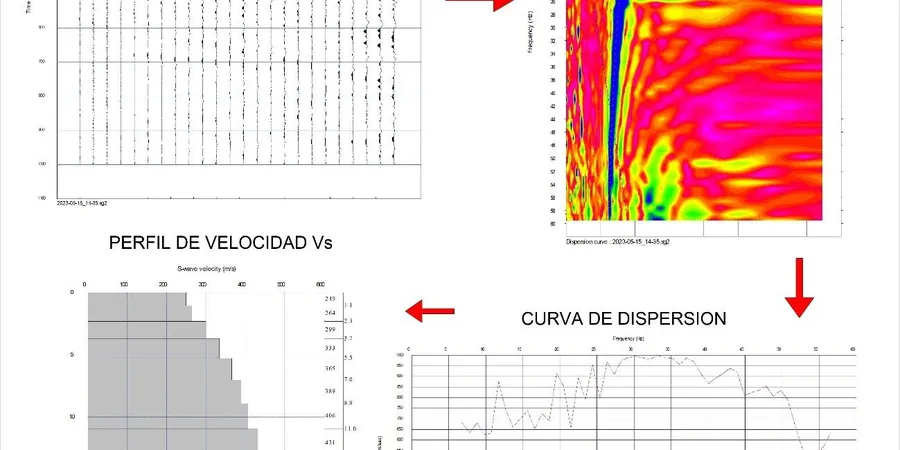
A recurring observation from our field crew is that you cannot trust surface geology alone to predict VS30 in Limerick city centre, because the medieval core sits on a complex fluvio-glacial sequence where stiff till lenses alternate with soft silts within the same 30-metre profile. The MASW method addresses this by deploying a 24-channel seismograph with 4.5 Hz geophones in a linear array, typically spanning 46 to 69 metres depending on target depth, and recording surface waves generated by a 10 kg sledgehammer source. The raw shot gathers are processed through dispersion analysis—picking the fundamental Rayleigh wave mode across a frequency band of 5 to 50 Hz—and then inverted iteratively using a least-squares algorithm to produce a 1D shear wave velocity profile that is accurate to within 10% when validated against downhole logs. We run every acquisition at two shot offsets to verify lateral homogeneity, and the final VS30 value is computed following the time-averaged travel path method defined in Section 3.5 of the NEHRP Provisions, which integrates the velocity of each layer over its thickness down to 30 metres. The entire procedure, from stakeout to final report, aligns with the guidelines of ASTM D7400-19 and the ISRM Suggested Method for surface wave testing.
MASW & VS30 Shear Wave Velocity Testing in Limerick
Technical reference — Limerick

Local considerations

The expansion of Limerick westward into former floodplain areas, accelerated by the construction of the N18 bypass and the growth of the Raheen Business Park, has placed new infrastructure directly atop soft compressible soils that were avoided by earlier generations of builders. The 2010 rezoning of lands near the Shannon estuary triggered a wave of industrial development where the seismic hazard—though moderate by global standards—combines with Class E or F site conditions to produce spectral ordinates that can govern the design of pile-supported structures. A VS30 below 180 m/s places a site in ground type D or even E under Eurocode 8, which mandates a soil factor S of 1.35 or higher and can double the required ductility detailing in reinforced concrete frames. Beyond code compliance, the layered velocity model from MASW is used directly in 1D equivalent-linear site response analyses (SHAKE2000 or DEEPSOIL) to compute surface acceleration time histories, giving structural engineers the site-specific spectra they need to avoid both over-conservatism in rock-founded areas and under-design in the alluvial corridor.

Need a geotechnical assessment?

Reply within 24h.

Email: contact@geotechnical-engineering.co

Applicable standards

Eurocode 8 (EN 1998-1:2004) with Irish National Annex, ASTM D7400-19: Standard Guide for Surface Wave Testing, NEHRP Provisions Section 3.5 (VS30 computation), ISRM Suggested Method for Surface Wave Testing, BS EN 1997-1:2004+A1:2013 for geotechnical investigation integration

Technical parameters

ParameterTypical value
Applicable Standard for MASWASTM D7400-19, ISRM Suggested Method
Geophone Array Configuration24-channel, 4.5 Hz vertical geophones
Typical Array Length in Limerick46 m to 69 m (depending on target depth)
Source Type10 kg sledgehammer on aluminium plate
Frequency Range Analyzed5 Hz to 50 Hz (fundamental Rayleigh mode)
Inversion AlgorithmIterative least-squares with up to 10 layers
VS30 Calculation MethodNEHRP time-averaged travel path (30 m depth)
Seismic Site Class DeterminationEurocode 8 Part 1 (EN 1998-1:2004) Table 3.1

Frequently asked questions

How much does a MASW / VS30 survey cost for a standard residential site in Limerick?

For a typical single-building plot within the Limerick city area, a MASW survey with VS30 calculation and Eurocode 8 site classification ranges from €1,720 to €3,120, depending on the array length required to reach 30-metre depth and the number of measurement locations specified by the consulting engineer.

What depth do you need to reach for a compliant VS30 value under Irish regulations?

The VS30 parameter integrates velocities down to exactly 30 metres below ground surface. If the MASW array cannot resolve that full depth—common when space is restricted on built-up Limerick sites—we combine surface wave data with any available borehole logs or CPT soundings to extrapolate the deeper velocity structure, but the preferred approach is always a direct measurement to the full 30 metres.

How do the soft river deposits along the Shannon affect the seismic site classification?

The estuarine silts and clays along the Shannon corridor typically exhibit shear wave velocities between 120 and 200 m/s in the upper 10 to 15 metres, which can drag the VS30 below the 180 m/s threshold for ground type D. In several projects near the Docklands, we have measured VS30 values as low as 160 m/s, resulting in a Eurocode 8 soil factor S of 1.35 or higher and a corresponding increase in the design spectral acceleration plateau.

Location and service area

We serve projects across Limerick and its metropolitan area.

View larger map