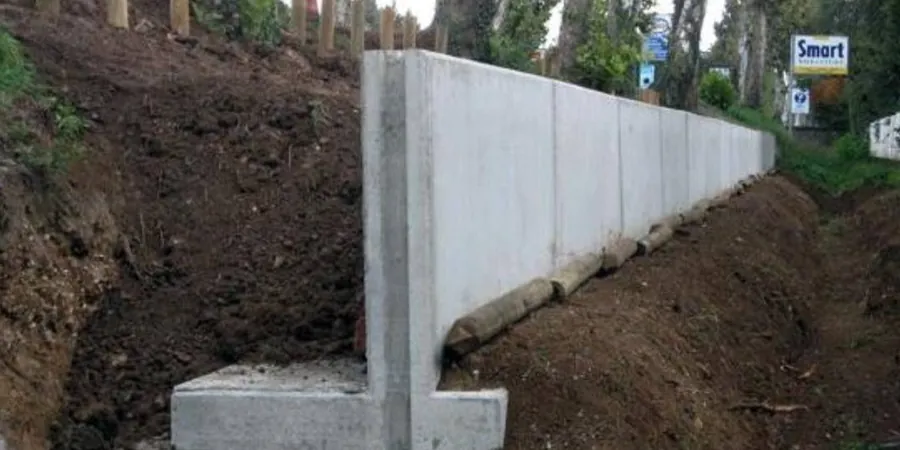
In Limerick, retaining wall design is seldom a straightforward exercise in textbook selection. The city straddles the River Shannon, and much of the suburban fringe sits on glacial till and limestone-derived boulder clay that can vary from stiff to soft within a single site. Groundwater here is notoriously high, especially on the south side near the estuary, where tidal lag in the alluvial silts creates daily fluctuations in pore pressure. A wall that performs well on the well-drained gravels of Castletroy may be wholly unsuitable for the compressible estuarine deposits found closer to the Docklands. The design process therefore begins not with a wall type but with a careful reading of the site investigation: the plasticity of the clay, the depth to rock, and the seasonal water table. In our experience across the mid-west, the most cost-effective solution often emerges only after reconciling the geometry of the excavation with the stiffness of the ground, and that demands a ground investigation with test pits and boreholes calibrated to the specific stratigraphy of the Shannon basin.
In Limerick's boulder clay, a retaining wall design that ignores seasonal groundwater fluctuation will show distress within the first five years, regardless of the structural reinforcement.
Methodology and scope
Limerick's built form has expanded dramatically since the 1990s, pushing new housing and commercial development onto the Drumlin belt that wraps around the city. These low, rounded hills of glacial origin present a particular challenge for retaining wall design: the till is dense at depth but often weathered to a silty clay in the upper two metres, and it erodes quickly if left exposed to the Irish winter rains. Historically, the Georgian core of the city relied on limestone gravity walls with lime-mortar joints, many of which are still performing two centuries later because they were founded directly on the underlying Carboniferous limestone. Modern practice, governed by Eurocode 7 (EN 1997-1:2004) and the Irish National Annex, demands a more analytical approach. Wall design today integrates partial factors on actions and material strengths, with Design Approach 1 being the convention in Ireland. For the boulder clay typical of the Corbally and Dooradoyle areas, drained shear strength parameters — c' and φ' — are essential inputs, and these are obtained from triaxial testing on undisturbed Shelby tube samples. The choice between a cantilever, propped, or anchored wall is then a function of retained height, allowable deflection, and the proximity of adjacent structures, with a growing preference for reinforced concrete cantilever walls in residential developments where backfill compaction can be controlled.