GEOTECHNICAL ENGINEERING
LIMERICK
HomeLaboratory

Laboratory in Limerick

Evidence-based design. Reliable delivery.

LEARN MORE

Our Limerick laboratory services provide essential geotechnical classification of soils in accordance with Irish Standard I.S. EN ISO 17892, supporting accurate ground models for the region's diverse geology. From the glacial tills and alluvial deposits along the River Shannon to the underlying Carboniferous limestone bedrock, precise physical testing is critical. Core procedures include grain size analysis combining sieving and hydrometer methods to determine particle distribution, and Atterberg limits testing to establish liquid and plastic limits for fine-grained soils.

These index tests are fundamental for foundation design, road construction, and drainage assessments on residential, commercial, and infrastructure projects across Limerick city and county. Contractors and consultants rely on accurate classification for earthworks specification and verifying the suitability of cohesive fill materials. Our facility also integrates these results with complementary strength and consolidation testing for comprehensive compliance reporting.

Available services

Grain size analysis (sieve + hydrometer)

→ Ver detalle

Atterberg limits

→ Ver detalle

Walking onto a Limerick site, the first thing you notice is the drilling rig setup. For anchor installations in the city centre or out by the Raheen Business Park, the mast has to be angled precisely — usually between 15 and 30 degrees from horizontal — to reach into the competent limestone or dense till. The hollow-stem auger or rotary-percussive head cuts through the overlying boulder clay, and you see the crew threading the high-tensile steel tendon inside the borehole before the tremie pipe pumps neat cement grout from the bottom up. Limerick sits at roughly 52.66°N, where winter rain saturates the glacial drift, so the rig often works with a temporary casing to keep the hole open in the silty upper layers. Every anchor assembly — whether active with a stressing jack or passive without preload — follows the execution standard I.S. EN 1537:2013, and the load is verified by on-site suitability testing. When the ground gets tricky near the Shannon estuary, we frequently combine the anchor pattern with a deep excavation monitoring plan to track wall deflection during staged excavation.

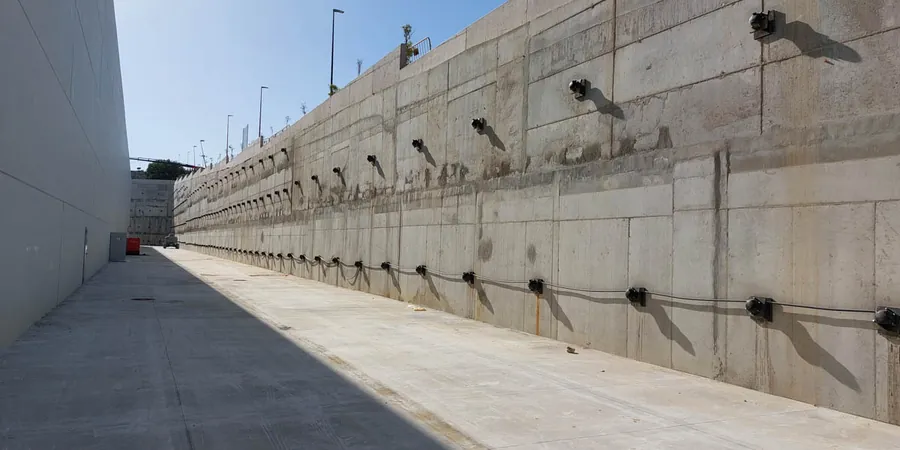
An active anchor is not just a tieback — it is a preloaded structural element that controls wall displacement before the next excavation lift begins.
Our service areas

Methodology and scope

Picture a four-level basement excavation on Henry Street, right beside an old Georgian building with shallow strip footings. The contractor needs to go down 12 metres, and the retaining wall is a secant pile system tied back with two rows of active anchors. The upper row sits about 2.5 m below street level, drilled through stiff sandy till that has a friction angle around 34 degrees. Each anchor is stressed to 450 kN using a hydraulic jack, and the load is locked off against a steel wale. Five metres lower, the second row passes into weathered limestone, where the bond length relies on rock-grout adhesion, and the unbonded length is sheathed to prevent load transfer near the wall. This is classic Limerick ground — till over karstic limestone, with occasional clay seams that can reduce the ultimate bond stress to below 200 kPa if not identified early. We pull triaxial strength data from the site investigation to calibrate the bond capacity, and the anchor spacing is adjusted based on the slope stability analysis of the temporary excavation face. Passive anchors — often fully grouted bars — work well for rockfall drapery on the steeper cuttings along the N7 approach, where no pre-tensioning is needed, just a reliable bond into sound bedrock.
Active and Passive Anchor Systems for Limerick's Glacial Soils
Technical reference — Limerick

Local considerations

There is a marked difference between the floodplain soils near Corbally and the higher ground around Dooradoyle. Along the Shannon side, the alluvial silts and soft clays extend 6 to 8 metres deep, with undrained shear strength sometimes below 30 kPa. A passive anchor grouted into that material will creep under sustained load unless the bond length is substantially increased or the anchor is socketed into the underlying limestone. Compare that to the dense lodgement till in Castletroy, where an active anchor can develop its full design load within a shorter, stiffer bond zone. The biggest risk in Limerick is not the anchor steel itself — it is misjudging the bond zone geology. A single unmapped clay seam in the limestone can halve the grout-rock adhesion, and if the proof load test is skipped, that deficiency stays hidden. When working near the tidal Shannon, corrosion protection also moves to the front: double-corrosion-protected (DCP) anchors with corrugated sheathing and factory-applied grease are standard practice to meet the 100-year design life for permanent works.

Need a geotechnical assessment?

Reply within 24h.

Email: contact@geotechnical-engineering.co

Explanatory video

Applicable standards

IS EN 1997-1:2005 + Irish National Annex (Geotechnical design), I.S. EN 1537:2013 (Execution of special geotechnical works — Ground anchors), I.S. EN 1992-1-1:2004 + NA (Design of concrete anchor heads and capping beams), I.S. EN 10080 (Steel for reinforcement — tendon bars), IS EN 1993-5 + NA (Steel piles and anchor components)

Technical parameters

ParameterTypical value
Anchor typeActive (stressed) / Passive (unstressed)
Design standardIS EN 1997-1:2005 + Irish National Annex
Execution standardI.S. EN 1537:2013
Typical bond length in till3.5 – 8.0 m
Typical bond length in limestone2.5 – 5.0 m
Tendon steel gradeY1860S7 (15.7 mm strands) or GEWI bars
Acceptance criteriaInvestigation + suitability tests per IS EN 1537

Frequently asked questions

What is the difference between an active and a passive ground anchor?

An active anchor is tensioned with a hydraulic jack after grouting to apply a predefined preload to the structure — this controls movement from the start. A passive anchor is fully grouted but not stressed; it only mobilises resistance once the ground or structure deforms enough to activate it. Active anchors are typical for tied-back retaining walls in Limerick city excavations, while passive anchors see more use in rock slope stabilisation and small retaining structures.

How much does an anchor design and testing package cost for a Limerick project?

The fee for a complete anchor design package — covering capacity calculations, bond length verification, corrosion protection specification, and on-site suitability testing supervision — typically falls between €830 and €3,400, depending on the number of anchor rows, the complexity of the ground profile, and whether permanent or temporary anchors are specified.

Why is corrosion protection so critical for anchors in Limerick?

The combination of tidal influence along the Shannon, high rainfall, and the presence of glacial tills with variable pH creates a moderately aggressive ground environment. Permanent anchors must meet I.S. EN 1537 requirements for double corrosion protection, which includes a corrugated plastic sheathing, factory-applied grease or grout cover, and sealed anchor heads. Without it, steel tendons in Limerick soils can develop pitting corrosion within a decade, compromising long-term structural safety.

Location and service area

We serve projects across Limerick and its metropolitan area.

View larger map