GEOTECHNICAL ENGINEERING
LIMERICK
HomeInvestigationCPT (Cone Penetration Test)

CPT (Cone Penetration Test) in Limerick — Continuous Stratigraphic Profiling for Riverine and Glacial Soils

Evidence-based design. Reliable delivery.

LEARN MORE

Limerick’s development from a Viking settlement on King’s Island to a modern urban centre expanding across the Shannon floodplain has left a distinct geotechnical fingerprint. The medieval core rests on soft alluvial silts and organic clays, while the southern suburbs climb onto Carboniferous limestone with a patchy mantle of glacial till. Every new bridge approach, quay wall rehabilitation, or campus extension at the University of Limerick presses against these transitions. A standard borehole log will tell you what was recovered at discrete intervals, but it will not show the continuous shift in tip resistance and sleeve friction that separates a marginally stable silt from a fully consolidated clay lens. For that continuous profile, the CPT (Cone Penetration Test) is the tool the laboratory team deploys most often on the Shannon corridor, where pore pressure dissipation tests also help assess consolidation rates in the estuarine clays that underlie much of the city centre. When the stratigraphy is as layered as the soils beneath Limerick, the difference between a design assumption and a construction problem often hides in a 200 mm band that only a cone can read.

In Limerick’s tidal alluvium, a 200 mm silt lens missed by SPT can shift pile set prediction by metres — the CPT’s continuous 20 mm log catches what discrete sampling cannot.
Our service areas

Methodology and scope

Limerick sits barely 10 m above sea level along the Shannon, with the river tidal as far as the city docks. That low elevation means groundwater is rarely more than 2 m below ground surface across the city centre and Docklands regeneration area, and artesian conditions occur where the limestone bedrock is confined beneath the glacial till. In these saturated, low-strength profiles, the CPT test carried out with a piezocone yields three continuous channels: corrected cone resistance (qt), sleeve friction (fs), and pore pressure (u2). Our laboratory pushes a 15 cm² or 10 cm² cone at the standard 20 mm/s rate, measuring every 20 mm of depth. Typical qt values in the Shannon alluvium range between 0.2 and 0.8 MPa, with friction ratios above 4 % indicating plastic silts and clays of high compressibility. Where the till is present, qt climbs to 5–15 MPa, and the friction ratio drops below 2 %, a signature the team uses to map bearing strata for driven piles. A seismic refraction survey run in parallel helps correlate the cone refusal depth with the top of rock, especially in zones where the limestone is pinnacled or contains mud-filled karst cavities, a recognised hazard in the Limerick region that standard probing alone can misinterpret as competent rock.
CPT (Cone Penetration Test) in Limerick — Continuous Stratigraphic Profiling for Riverine and Glacial Soils
Technical reference — Limerick

Local considerations

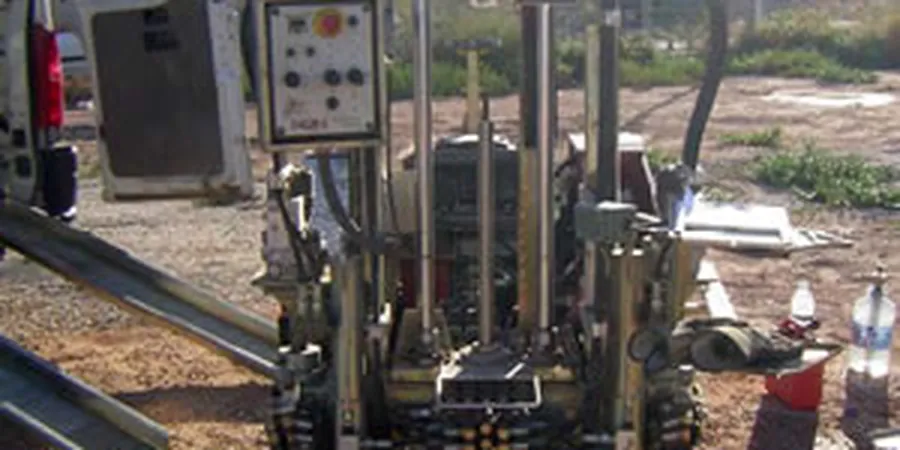
The CPT rig used on Limerick sites is a 20-tonne tracked machine with a hydraulic thrust system that pushes the cone rods continuously from the surface — no pre-drilling, no casing, no cuttings. The risk picture here is dominated by karst: the Waulsortian limestone beneath the city is riddled with solution features, and a cone that suddenly drops into a mud-filled cavity produces a zero-resistance spike that can be misread as very soft clay unless the operator cross-checks pore pressure decay and sleeve friction simultaneously. Equally dangerous is refusal on a pinnacle at 8 m depth when the true rockhead lies at 14 m; the laboratory protocol requires a seismic check or a nearby rotary borehole whenever refusal is abrupt and depth-inconsistent with the regional geological model. Soft-ground hazards include loss of saturation at the filter element in desiccated crust layers, which delays pore pressure response, and rod buckling in very soft clays if the thrust is not reduced. Every CPT sounding in Limerick city centre is logged with live pore pressure monitoring to catch artesian breaks before they compromise the hole.

Need a geotechnical assessment?

Reply within 24h.

Email: contact@geotechnical-engineering.co

Applicable standards

ISO 22476-1:2012 — Geotechnical investigation and testing — Field testing — Part 1: Electrical cone and piezocone penetration test, Eurocode 7 (EN 1997-2:2007) — Ground investigation and testing, Section 4: Cone penetration tests, IS EN ISO 22476-12:2009 — CPT mechanical cone (Irish adoption), NSAI National Annex to Eurocode 7 for CPT-derived pile design parameters in Irish glacial soils

Technical parameters

ParameterTypical value
Cone typePiezocone (CPTu) with u2 filter element, 15 cm² base area
Penetration rate20 mm/s ± 5 mm/s per ISO 22476-1:2012
Measurement interval20 mm continuous (qt, fs, u2)
Typical qt in Shannon alluvium0.2 – 0.8 MPa
Typical qt in Limerick glacial till5 – 15 MPa
Friction ratio (Rf) range — soft clays4 – 8 %
Pore pressure dissipation (t50)Recorded at target depths; typical t50 5–60 min in estuarine clay
Maximum thrust capacity20 tonnes (200 kN) on tracked rig; refusal defined at qt ≥ 50 MPa or inclination > 15°

Frequently asked questions

How deep can a CPT rig penetrate in Limerick’s soils?

In the soft alluvial silts along the Shannon, the 20-tonne rig routinely reaches 20–25 m depth before encountering glacial till. Where the till is dense or the limestone rockhead is shallow — common on the south side of the city towards Dooradoyle — refusal typically occurs between 8 and 15 m. The laboratory always assesses refusal carefully because pinnacled limestone can stop the cone prematurely; a parallel seismic refraction line or rotary borehole is recommended when refusal is abrupt and depth-inconsistent with the surrounding geology.

Can CPT distinguish between the alluvial clays and the glacial till?

Yes, and the distinction is usually unambiguous. The Shannon alluvium returns corrected cone resistance (qt) of 0.2–0.8 MPa with friction ratios above 4 %, while the Limerick glacial till gives qt of 5–15 MPa with friction ratios below 2 %. The pore pressure channel adds further discrimination: the alluvium generates high excess pore pressure during penetration, whereas the till is largely drained. This signature allows the team to map the till surface accurately for end-bearing pile design.

What is the typical cost of a CPT sounding in Limerick?

A single CPTu sounding to 15–20 m depth in the Limerick area generally falls in the range of €170 to €240 per metre, depending on access conditions, traffic management requirements, and whether seismic cone (SCPT) or dissipation testing is included. Mobilisation is charged separately and varies with the number of soundings per visit. A formal quotation is provided after a desk study of the site geology and a review of the proposed test depths.

Is CPT accepted by Limerick City and County Council for foundation design?

Yes, CPT data is fully accepted for Building Control (Amendment) Regulations submissions in Limerick, provided the testing is carried out to IS EN ISO 22476-1 and interpreted by a chartered geotechnical engineer. For pile design, the laboratory supplies the reduced data in digital format (GEF or CSV) with a factual report, and the design engineer applies the LCPC or ICP-05 method using the qt and fs profiles. The Council’s building control department may request a correlating borehole in karst-affected areas to confirm rockhead quality.

Location and service area

We serve projects across Limerick and its metropolitan area. More info.

View larger map