GEOTECHNICAL ENGINEERING
LIMERICK
HomeLaboratoryLaboratory CBR test

Laboratory CBR Test in Limerick: Reliable Soil Strength for Pavement Design

Evidence-based design. Reliable delivery.

LEARN MORE

Transport Infrastructure Ireland (TII) specifies the California Bearing Ratio in its pavement design manuals, and for Limerick projects the soaked CBR value is non-negotiable. The city averages over 970 mm of annual rainfall, which means subgrade saturation is the design condition, not the exception. Our laboratory team runs CBR tests on remolded samples compacted at optimum moisture content, then soaks them for 96 hours before penetration. The result feeds directly into the capping and sub-base thickness calculations that determine whether your pavement budget holds or blows out. For road schemes near the Shannon estuary, where alluvial silts dominate, we often pair the soaked CBR with a grain-size analysis to confirm fines content before compaction, and recommend Proctor tests to establish the reference density curve used during sample preparation.

A one-percent drop in CBR can increase pavement thickness by 40 mm. In Limerick's wet subgrades, getting the soaked value right is the difference between a 20-year road and a maintenance headache.
Our service areas

Methodology and scope

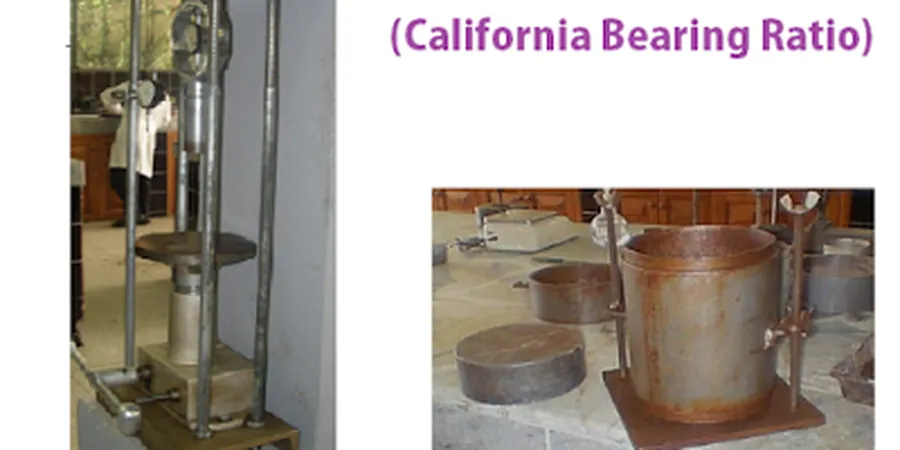
The test apparatus itself is a motorized loading frame pushing a 49.6 mm diameter plunger into a compacted specimen inside a standard CBR mold. Force readings come from a calibrated proving ring or electronic load cell, while penetration is tracked by a dial gauge reading to 0.01 mm. The specimen sits in a soaking tank with a surcharge ring simulating pavement weight, and we monitor swell daily using a tripod-mounted dial indicator. I.S. EN 13286-47 demands penetration readings at 0.625 mm intervals up to 7.5 mm, then a pause at 10 mm. The CBR values at 2.5 mm and 5 mm penetration are computed as percentages of standard loads—13.7 kN and 20.3 kN respectively. If the CBR at 5 mm exceeds that at 2.5 mm, the test gets repeated; that rule alone catches many labs off guard. We use automatic data acquisition to eliminate transcription errors, and every load ring carries a current UKAS-traceable calibration certificate.
Laboratory CBR Test in Limerick: Reliable Soil Strength for Pavement Design
Technical reference — Limerick

Local considerations

Limerick sits on a geological transition: Carboniferous limestone bedrock under the city center gives way to alluvial deposits and estuarine clays along the Shannon. These low-plasticity silts and fine sands lose significant strength when saturated, and CBR values can drop from 8% down to 2% after soaking. A pavement designed on unsoaked CBR figures will rut within the first wet winter. The Docklands redevelopment area and the M20 corridor both cross these problematic soils. We test at three compaction levels—typically 10, 30, and 65 blows per layer—to generate a CBR-density curve that lets the designer pick the target field compaction. For sites near the tidal reaches of the Abbey River, groundwater sits within 1.5 m of the surface, and the soaked CBR test replicates exactly what happens once the water table rises under the finished pavement.

Need a geotechnical assessment?

Reply within 24h.

Email: contact@geotechnical-engineering.co

Applicable standards

I.S. EN 13286-47:2021 – Unbound and hydraulically bound mixtures – Test method for CBR, TII Publication CC-SPW-01200 – Specification for Road Works Series 600 Earthworks, I.S. EN 13286-2 – Proctor compaction reference for CBR specimen preparation, NRA HD 26/06 – Pavement and Foundation Design (superseded but still referenced locally)

Technical parameters

ParameterTypical value
Standard appliedI.S. EN 13286-47:2021
Plunger diameter49.6 ± 0.1 mm
Penetration rate1.27 mm/min
Soaking period (soaked CBR)96 hours (4 days)
Surcharge mass4.5 kg minimum (annular discs)
Compactive effortStandard or Modified Proctor per I.S. EN 13286-2
Mold dimensions152 mm diameter × 127 mm height
Swell measurementDaily readings over soak period

Frequently asked questions

What does a laboratory CBR test cost in Limerick?

A single-point soaked CBR test with 96-hour soaking typically runs between €120 and €200, depending on whether the Proctor compaction reference is done separately or included. A full three-point CBR-density package costs proportionally more but gives the design engineer far more flexibility to optimize pavement sections.

How long does it take to get CBR results?

A soaked CBR test takes a minimum of five working days: one day for compaction and setup, four days of soaking with daily swell readings, and the penetration plus reporting on day five. Unsoaked CBR can be turned around in 24 hours. We always quote based on lab workload at the time of booking.

Why does TII require soaked CBR instead of unsoaked?

Ireland's climate means subgrade soils spend most of their design life at or near saturation. A soaked CBR test replicates the weakest condition the soil will experience in service. Designing to unsoaked values leads to under-designed pavements that rut and crack prematurely, especially in Limerick where annual rainfall exceeds 970 mm.

Can you test site-won material or does it have to be bulk samples?

We can work with either. Ideally, you bring us 25-30 kg of representative bulk sample in sealed bags so we control the entire process. If you have material already compacted in CBR molds from site, we can soak and penetrate those directly—just make sure the molds arrive sealed to prevent moisture loss.

What happens if the CBR at 5 mm is higher than at 2.5 mm?

I.S. EN 13286-47 requires the test to be repeated. It usually indicates a seating error—the plunger wasn't fully in contact with the specimen surface at zero reading—or a non-uniform density in the compacted layer. We catch this during the test because we plot force-penetration in real time. If it happens, we re-compact a fresh specimen and re-run the whole procedure.

Location and service area

We serve projects across Limerick and its metropolitan area.

View larger map