GEOTECHNICAL ENGINEERING
LIMERICK
HomeGround improvementStone column design

Stone Column Design in Limerick: Ground Improvement on Alluvial Soils

Evidence-based design. Reliable delivery.

LEARN MORE

Limerick's expansion from a Viking settlement on King's Island to a modern city stretching into the Shannon estuary floodplain has created a challenging geotechnical legacy. The historic core sits on relatively shallow boulder clay over limestone, but within a kilometer, you encounter the alluvial silts and peats of the River Shannon valley, where bearing capacity can drop below 50 kPa. For any load-bearing structure on these soft soils—whether a warehouse in Raheen Business Park or a residential block near the Docklands—stone column design becomes a primary option, not an afterthought. We approach each Limerick site with a risk-based framework tied directly to IS EN 1997-1:2005, incorporating Eurocode 7 design approaches for the ground improvement element. The goal is clear: control total and differential settlement while increasing the composite ground's stiffness to meet the project's performance criteria.

On Limerick's estuary silts, a well-designed stone column grid can reduce settlement by 60% and accelerate primary consolidation from years to weeks.
Our service areas

Methodology and scope

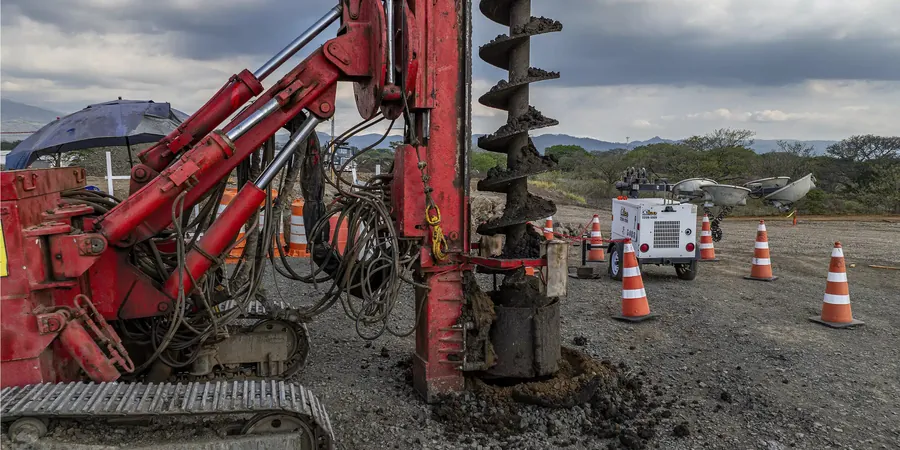
The equipment mobilized for a Limerick job is configured around the city's specific subsurface profile: a thin desiccated crust over soft, normally consolidated silts extending 6 to 12 meters deep. We typically deploy a bottom-feed vibroflot with a 500 mm diameter poker, capable of constructing stone columns to 15 meters depth. The system operates at 180-200 bar hydraulic pressure with a 130 kW power pack, advancing through the soft layers and penetrating a minimum of 1 meter into the underlying competent glacial till or limestone bedrock. Crushed limestone aggregate, sourced from local quarries within County Limerick, is used—its angularity and 40-60 mm nominal size deliver the high internal friction angle required for load transfer. Real-time data is captured via an on-board monitoring system, measuring depth, amperage, and stone consumption every 0.5 seconds. This digital record is cross-referenced with the CPT test profiles we run before installation to confirm that each column has fully penetrated the compressible layer and reached design refusal.
Stone Column Design in Limerick: Ground Improvement on Alluvial Soils
Technical reference — Limerick

Local considerations

A 10-story mixed-use building on a brownfield site along the Dock Road showed us the cost of underestimating Limerick's subsurface variability. The ground investigation revealed 8 meters of silty clay with organic layers, classified as Class 3 soil under the TII Specification for Road Works. The client's initial design assumed a standard raft foundation, but our settlement analysis indicated 120 mm of total settlement and 45 mm of differential settlement—well beyond the 25 mm serviceability limit. We redesigned the foundation using a grid of 700 mm diameter stone columns at 2.2 m centers, achieving a composite deformation modulus of 18 MPa. This brought the calculated settlement under the 25 mm threshold and eliminated the need for deep piling. Ignoring the lateral extent of the soft zone, which varied by 3 meters across the footprint, would have led to unacceptable tilt and long-term structural issues.

Need a geotechnical assessment?

Reply within 24h.

Email: contact@geotechnical-engineering.co

Applicable standards

IS EN 1997-1:2005 (Eurocode 7: Geotechnical design), IS EN 14731:2005 (Execution of special geotechnical work – Ground treatment by deep vibration), BRE Digest 433 (Specification for vibro stone columns), TII Publication CC-SPW-01200 (Specification for Road Works – Series 600)

Technical parameters

ParameterTypical value
Design StandardIS EN 1997-1:2005 + IS EN 14731:2005
Typical Column Diameter600 to 900 mm
Typical Depth Range (Limerick)6 to 15 m
Area Replacement Ratio (a_s)10% to 35%
Stone Aggregate SpecificationCrushed limestone 40-60 mm, LA < 30
Quality Control MethodCPT post-installation + zone load test
Primary Consolidation Time2 to 4 weeks with radial drainage

Frequently asked questions

How much does stone column design and testing cost for a typical Limerick project?

For a site in Limerick requiring a full design package—including CPT investigation, settlement analysis, and post-installation verification—the cost typically ranges from €1,420 to €5,390, depending on the number of columns, the depth of the soft layer, and the extent of acceptance testing required.

Why are stone columns preferred over piles in the Shannon floodplain?

Stone columns are often selected when the soft soil depth is less than 15 meters and the structure is lightly to moderately loaded. They improve the ground mass rather than bypassing it, which can reduce foundation costs by 30-50% compared to piling, while also accelerating consolidation through radial drainage.

What ground investigation is needed before stone column design in Limerick?

We require a minimum of three CPT profiles to 15 meters depth, spaced across the building footprint, plus one borehole with sampling for Atterberg limits and oedometer testing. This captures the lateral variability in the Shannon alluvium that is critical for accurate settlement modeling.

How do you verify that the stone columns are working correctly?

Verification is a two-stage process: during installation, we monitor amperage, depth, and stone volume in real time on every column. After a 14-day consolidation window, we run CPT tests at the centroid of a column group and compare the tip resistance and sleeve friction against the untreated ground. A zone load test on a single column confirms the load-settlement behavior matches the design curve.

Location and service area

We serve projects across Limerick and its metropolitan area.

View larger map