GEOTECHNICAL ENGINEERING
LIMERICK
HomeSeismicSoil liquefaction analysis

Bridging Soil Liquefaction Risk in Limerick: Data-Driven Analysis for Ground Improvement

Evidence-based design. Reliable delivery.

LEARN MORE

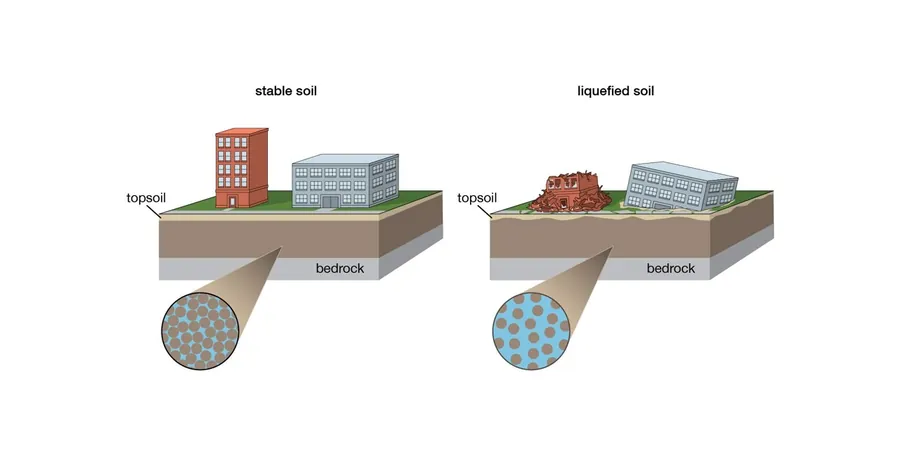
A recent mixed-use project along the Dock Road hit a snag at six meters: saturated silty sand that trembled under the rig. The developer needed a clear go/no-go for the foundation design, and fast. Limerick’s low-lying ground, shaped by the Shannon estuary and its tributaries, holds pockets of loose alluvium that can lose strength during a seismic event. Our team ran a targeted soil liquefaction analysis to map the susceptible layers and deliver a factor of safety against liquefaction (FSL) for every critical stratum. Before the boreholes were even backfilled, we had the answers the structural engineer needed. For deeper profiling, we often pair the investigation with a CPT test where access allows, since the continuous tip resistance and sleeve friction clarify transitions between dense and loose zones that SPT alone can miss. In tighter urban lots, a MASW survey provides the shear-wave velocity (Vs) profile needed to calculate the cyclic stress ratio (CSR) without extensive drilling, which proved essential behind the old Cleeve's factory site last spring.

Limerick's estuarine silts can transition from stable to liquefied with a shift in pore pressure of just a few kilopascals — the margin is that narrow.
Our service areas

Methodology and scope

The temperate maritime climate of Limerick means a shallow water table is the norm rather than the exception, especially in the floodplain deposits between Corbally and the city center. Saturated fine sands and low-plasticity silts dominate these corridors, and they are precisely the materials that demand a rigorous soil liquefaction analysis under EN 1998-5:2004. Our laboratory processes undisturbed samples retrieved with thin-walled Shelby tubes to measure the plasticity index and fines content, because even a 15% silt fraction can shift the cyclic resistance ratio (CRR) significantly. We cross-check field blow counts against the corrected SPT N-value (N1)60 and run cyclic triaxial tests when the project budget permits. A grain-size analysis on each representative specimen confirms the gradation curve, and we plot the results directly onto Tsuchida’s boundaries to identify the most liquefiable fractions. This is not a desk-study exercise; we calibrate every parameter against physical samples extracted from the boreholes on your site.
Bridging Soil Liquefaction Risk in Limerick: Data-Driven Analysis for Ground Improvement
Technical reference — Limerick

Local considerations

Eurocode 8 Part 1 (EN 1998-1:2004) and the Irish National Annex classify Limerick as a low-to-moderate seismicity zone, yet the ground conditions amplify the hazard considerably. A magnitude 4.5 event on the local fault system could generate enough peak ground acceleration to trigger flow failure in the estuarine deposits underlying the Docklands regeneration area. Soil liquefaction analysis is not a regulatory checkbox here; it is the only reliable method to prevent differential settlement that cracks partition walls and shears utility connections. When our factor of safety calculation falls below 1.1 in any layer, we immediately flag it and propose a ground improvement strategy. In past Limerick projects, we have designed vibrocompaction grids to densify the loose sands down to eight meters, and specified stone column drains where the silt content made pure densification ineffective. The cost of ignoring a liquefiable lens at four meters depth is a failed pile cap and a six-month delay.

Need a geotechnical assessment?

Reply within 24h.

Email: contact@geotechnical-engineering.co

Applicable standards

EN 1998-1:2004 + Irish National Annex, ASTM D6066-11 (Standard Practice for Determining the Normalized Penetration Resistance of Sands for Evaluation of Liquefaction Potential), ASTM D5311-13 (Load Controlled Cyclic Triaxial Strength of Soil)

Technical parameters

ParameterTypical value
Corrected SPT N-value (N1)60Measured in situ, corrected for overburden and hammer energy per ASTM D6066
Fines Content (FC)Percent passing #200 sieve, determined by wash (ASTM D1140)
Plasticity Index (PI)Atterberg limits on fines fraction to assess clay-like behavior (ASTM D4318)
Shear-Wave Velocity (Vs)Obtained via MASW or downhole seismic; used for Vs-based CRR
Cyclic Stress Ratio (CSR)Seed-Idriss simplified procedure for Mw 6.0 scenario
Factor of Safety (FSL)CRR / CSR per section; target > 1.25 for low-risk classification
Post-Liquefaction SettlementEstimated volumetric strain from Ishihara & Yoshimine (1992) curves

Frequently asked questions

How is the factor of safety against liquefaction calculated for a Limerick site?

We calculate the cyclic stress ratio (CSR) induced by the design earthquake and compare it to the cyclic resistance ratio (CRR) of the soil. CRR is derived from corrected SPT blow counts, CPT tip resistance, or shear-wave velocity, with corrections applied for fines content. The factor of safety is CRR divided by CSR; we typically target a minimum of 1.25 for standard structures in the Limerick Docklands area.

What is the typical cost range for a soil liquefaction analysis in Limerick?

For a site investigation that includes two to three boreholes with SPTs, sample collection, laboratory classification, and a full liquefaction assessment report, the budget generally falls between €2,130 and €3,740. The final figure depends on the depth to bedrock, the number of samples requiring cyclic triaxial testing, and the complexity of the ground improvement recommendations.

Can you assess liquefaction risk without drilling boreholes?

Yes, we can perform a preliminary screening using a MASW seismic survey to measure the average shear-wave velocity in the upper 30 meters (Vs30). This data feeds into the Vs-based CRR calculation. However, for a definitive factor of safety, we still recommend at least one borehole to confirm the fines content and plasticity, because Vs alone can overestimate the resistance of silty sands.

Which ground improvement methods work best in Limerick's estuarine soils?

Vibrocompaction is effective in clean sands with less than 10% fines, while stone columns or vibro-replacement perform better in the silty sands common along the Shannon. For sites with very soft clay interbeds, we have also specified rigid inclusions to transfer the structural load below the liquefiable horizon. The choice depends on the gradation curve and the depth of the critical layer.

Location and service area

We serve projects across Limerick and its metropolitan area.

View larger map