GEOTECHNICAL ENGINEERING
LIMERICK
HomeSeismicSeismic microzonation

Seismic Microzonation in Limerick: Site-Specific Ground Response

Evidence-based design. Reliable delivery.

LEARN MORE

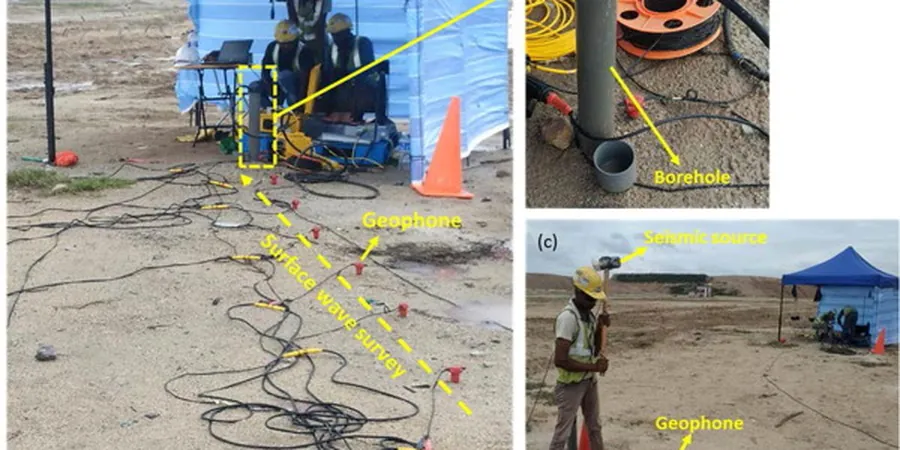
The Shannon Estuary’s deep alluvial clays and the Carboniferous limestone bedrock beneath Limerick create a sharp impedance contrast that amplifies seismic waves, even from distant offshore events. The city sits on a variable subsurface: stiff glacial till overlying karstified limestone in parts of the south side, while the docklands and floodplain near the Abbey River rest on 15 to 30 metres of soft estuarine silts. A uniform 0.7 m/s² PGA reference value means little without site-specific data. We run downhole shear-wave velocity surveys and MASW profiles to map VS30 across the site, feeding directly into EC8 ground-type classification. For projects near the river corridor, we often pair this with liquefaction screening, as the loose saturated silts at 4–8 m depth show cyclic resistance ratios that demand careful evaluation under the 475-year return period.

VS30 measured at 210 m/s reclassified a Limerick quayside site from Eurocode 8 Class E to Class C, cutting the design seismic coefficient by nearly 30%.
Our service areas

Methodology and scope

On a recent job at a quayside site, the borehole log showed 12 metres of soft clay over rock. The client assumed Site Class E and expected a high design spectrum. Our crosshole testing returned VS30 of 210 m/s, which put the site firmly in Class C — a significant reduction in the seismic coefficient for the structural engineer. That is the value of direct measurement over desk-study assumptions. We follow I.S. EN 1998-1:2005 for ground characterisation and run resonant column or cyclic triaxial tests where modulus degradation curves are needed for non-linear site response analysis. The work ties into slope stability studies when the project involves cut-and-fill on the drumlin slopes near Castletroy, where the dynamic behaviour of the glacial till changes the factor of safety under seismic load.
Seismic Microzonation in Limerick: Site-Specific Ground Response
Technical reference — Limerick

Local considerations

A developer on the Dock Road submitted a planning application with a generic Site Class D assumption. The foundation design used a correspondingly high seismic coefficient. When the planning authority requested a site-specific hazard study, our geophysical survey revealed a shallow limestone pinnacle at 6 metres with VS30 exceeding 400 m/s. The site was actually Class B. The structure was over-designed by more than 25%, and the pile lengths could be shortened by 4 metres. The opposite scenario is more dangerous: soft clay pockets hidden beneath a stiff crust can amplify ground motion and extend the fundamental period into resonance with mid-rise frames. Missing those pockets leaves a structure vulnerable.

Need a geotechnical assessment?

Reply within 24h.

Email: contact@geotechnical-engineering.co

Applicable standards

I.S. EN 1998-1:2005 (Eurocode 8 — Seismic design), I.S. EN ISO 17892 series (Geotechnical laboratory testing), I.S. EN ISO 22476-3:2005 (Standard penetration test), ASTM D7400-19 (Downhole seismic testing), NEHRP site classification methodology

Technical parameters

ParameterTypical value
VS30 range (quayside sites)160–280 m/s
Fundamental period (T0)0.15–0.40 s
Site class per I.S. EN 1998-1C or D (measured)
Depth to bedrock (south Limerick)2–15 m
Depth to bedrock (docklands)20–35 m
Peak ground acceleration (PGA) reference0.7 m/s² (bedrock)
Analysis method1D equivalent-linear (SHAKE) or 2D FEM

Frequently asked questions

When does Limerick City Council require a seismic microzonation study?

It is typically a planning condition for buildings over 15 m in height, structures in Importance Class III or IV (schools, hospitals, emergency facilities), or any project on the soft alluvial soils of the Shannon floodplain. The requirement comes through the site-specific ground investigation clause of I.S. EN 1998-1, Section 3.2.

What is the typical VS30 value for a Limerick city centre site?

There is no single typical value — that is the whole point of a microzonation study. We have measured VS30 from 170 m/s on deep clay near the river to over 500 m/s on shallow rock in the southern suburbs. A value of 220–260 m/s is common on the dense glacial till, which generally places sites in Class C.

How long does a full microzonation study take from commission to final report?

A standard scope including geophysical survey, drilling, and laboratory dynamic testing takes five to seven weeks. The field work is one to two weeks. The laboratory programme on the silt and till samples is the critical path item, running three to four weeks. The analysis and reporting take the final week.

Do you test for liquefaction potential in Limerick?

Yes. The loose saturated silts and fine sands in the estuarine deposits along the Shannon are susceptible. We run SPT-based screening using the NCEER (Youd-Idriss 2001) method and, where the factor of safety is marginal, follow up with cyclic triaxial tests on undisturbed samples to measure the cyclic resistance ratio directly.

What is the cost range for a seismic microzonation in Limerick?

A full study including geophysics, drilling, laboratory dynamics, and the site response analysis report typically runs from €3.970 to €17.100. The spread depends on the number of boreholes needed, the depth to bedrock, and whether cyclic triaxial or resonant column testing is required in addition to the standard field survey.

Location and service area

We serve projects across Limerick and its metropolitan area.

View larger map