GEOTECHNICAL ENGINEERING
LIMERICK
HomeGeophysicsSeismic tomography (refraction/reflection)

Seismic Tomography Surveys in Limerick: Refraction and Reflection for Infrastructure Projects

Evidence-based design. Reliable delivery.

LEARN MORE

A common mistake in Limerick is assuming bedrock depth is uniform. A 2022 commercial development near the Dock Road was redesigned after encountering a buried channel of the River Shannon at 22 meters — the preliminary desk study had suggested competent limestone at six. Seismic tomography eliminates this guesswork. Our refraction surveys map the overburden-bedrock interface across the city's complex Carboniferous formations, while reflection profiling resolves deeper structures down to 80 meters. The data feeds directly into foundation design and excavation monitoring programs, reducing the risk of change orders when karst features or alluvial pockets appear mid-construction.

A seismic refraction line costs a fraction of a blind overburden excavation and delivers a continuous velocity profile that no number of trial pits can match.
Our service areas

Methodology and scope

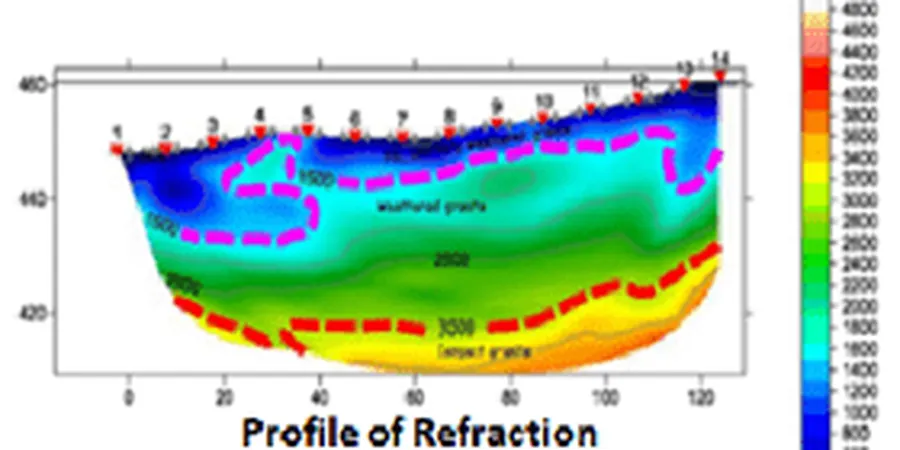
In Limerick, we often see that borehole-only investigations miss lateral variations in the Waulsortian mudbank limestones. A refraction line across a site in Raheen picked up a solution pipe that three boreholes had passed between. Our field setup uses a 24-channel seismograph with 10 Hz geophones at 2-meter spacing, generating a shot every 5 meters with a sledgehammer and accelerated weight drop source. Processing follows ASTM D5777-18 and the plus-minus method for intercept times. The result is a continuous 2D P-wave velocity model. For deeper targets, we run CDP reflection lines with 100 Hz geophone arrays and CMP stacking. The velocity data also calibrates MASW inversions for Vs30 profiling when we need to classify the site per EN 1998-1 seismic categories.
Seismic Tomography Surveys in Limerick: Refraction and Reflection for Infrastructure Projects
Technical reference — Limerick

Local considerations

Ground conditions change sharply between the medieval core of Limerick and the suburban extensions into County Clare. The city centre sits on alluvial silts and gravels of the Shannon floodplain — low velocities around 400–600 m/s, with amplification potential under long-period shaking. Cross the river into Corbally and you are immediately onto glacial tills over Namurian shales, where velocities jump above 1,800 m/s within 3 meters of the surface. A one-size-fits-all ground model fails here. Refraction tomography quantifies these transitions before the first pile is driven. The worst outcome we see is a slope stability assessment based on interpolated borehole data that misses a low-velocity lens of peat or soft clay — the tomography would have flagged it clearly.

Need a geotechnical assessment?

Reply within 24h.

Email: contact@geotechnical-engineering.co

Explanatory video

Applicable standards

ASTM D5777-18: Standard Guide for Using the Seismic Refraction Method, Eurocode 7 (EN 1997-2:2007): Ground investigation and testing, Eurocode 8 (EN 1998-1:2004): Seismic design — site classification via Vs30, ISRM Suggested Methods for Rock Characterization, I.S. EN ISO 22476-1:2023 (related in situ testing framework)

Technical parameters

ParameterTypical value
MethodSeismic refraction (P-wave) / Seismic reflection (P-wave, SH-wave)
StandardASTM D5777-18, Eurocode 7 (EN 1997-2:2007)
Geophone array24-channel, 10 Hz vertical (refraction); 100 Hz (reflection)
SourceAccelerated weight drop / 8 kg sledgehammer on aluminium plate
Maximum depth of investigation40 m (refraction); 80 m (reflection, depending on stratigraphy)
Output2D P-wave velocity tomogram, bedrock surface map, rippability log
Typical survey length115–230 m per line, with 1–2 m geophone spacing
Data formatSEG-2, SEG-Y, DXF, CSV, PDF report

Frequently asked questions

What is the typical cost of a seismic refraction survey in Limerick?

For a standard 115-meter refraction line with 24 geophones, budget between €2,500 and €4,680 depending on site access, surface conditions (asphalt vs. soft ground), and reporting requirements. Reflection lines and crosshole tomography sit at the upper end of this range. Every quotation includes processing, interpretation, and a signed report from our geophysicist.

How deep can seismic refraction see in the Limerick city centre alluvium?

In the Shannon floodplain deposits, refraction typically reaches 25–35 meters with a 115-meter spread and a weight-drop source. The depth depends on the velocity contrast between the soft alluvium (400–800 m/s) and the underlying limestone bedrock (above 2,500 m/s). This contrast is usually sharp enough to give a clear refractor. If the water table is high — common near the docks — the saturated sediments actually improve energy transmission and deepen the investigation slightly.

Can seismic tomography detect the karst features typical of the Limerick region?

Yes, refraction tomography is one of the best tools for mapping karst in the Waulsortian limestone. Solution pipes, cavities, and clay-filled fissures appear as pronounced low-velocity anomalies — often below 1,200 m/s — surrounded by competent rock above 2,800 m/s. The method will not image a small 0.3-meter void at 15 meters depth, but it reliably detects the broader zone of disturbed, fractured rock around a significant karst feature. We always recommend combining tomography with targeted rotary drilling for ground-truthing.

What surface preparation is needed for a seismic line on a Limerick greenfield site?

Minimal. We need a roughly straight corridor about 120 meters long, cleared of heavy brush. Geophones are planted with a spike into soil or fixed to asphalt with adhesive plates. If cattle are present — common on sites outside the M7 — we fence off the spread temporarily. The energy source (weight drop or sledgehammer) requires a firm contact surface; loose ploughed soil may need a few passes with a roller to improve coupling. We manage all logistics, including traffic management if a line crosses a quiet road.

Location and service area

We serve projects across Limerick and its metropolitan area.

View larger map