GEOTECHNICAL ENGINEERING
LIMERICK
HomeLaboratoryTriaxial test

Triaxial Testing in Limerick: Shear Strength Under Confined Conditions

Evidence-based design. Reliable delivery.

LEARN MORE

Ground conditions shift dramatically as you move from the medieval core of King's Island onto the quaternary deposits south of the Shannon. Under English Town the limestone bedrock lies shallow, often within two metres of paving, yielding competent bearing strata with minimal overburden. Cross the Sarsfield Bridge into the Docklands and you encounter interbedded alluvial silts and soft organic clays that continue deepening toward Raheen. These contrasts demand more than index testing. A consolidated-undrained triaxial test captures the effective stress parameters that standard penetration alone cannot resolve, while a CPT campaign can map the lateral extent of the soft lenses before sampling begins.

A CU-pp triaxial suite on Limerick alluvium typically yields an effective friction angle between 28 and 34 degrees, depending on silt content and overconsolidation ratio.
Our service areas

Methodology and scope

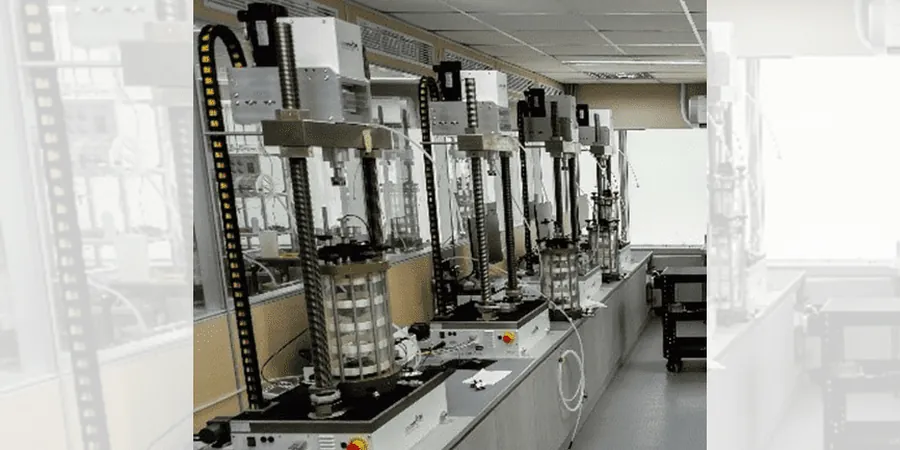
Our triaxial cell in Limerick operates with a Bishop & Wesley double-bellofram ram system capable of holding confining pressures up to 2 MPa, which covers the full depth range of typical infrastructure projects along the N18 corridor. Specimens are extruded from thin-walled Shelby tubes, trimmed to a 50 mm diameter with a 2:1 height ratio, and saturated under back-pressure until Skempton's B parameter exceeds 0.95. The test sequence runs either unconsolidated-undrained (UU) for immediate construction stages or consolidated-undrained with pore pressure measurement (CU-pp) when the client needs effective stress envelopes for drained long-term analysis. Every membrane, porous stone and filter strip comes from a single batch calibration to keep systematic error below 2 percent across the suite. We also run consolidated-drained (CD) protocols when requested for slope stability assessments where the Limerick County Council requires drained friction angles for cut sections in glacial till.
Triaxial Testing in Limerick: Shear Strength Under Confined Conditions
Technical reference — Limerick

Local considerations

Limerick's expansion during the 1970s pushed residential estates onto drumlin flanks and floodplain margins where the subsoil had never carried engineered fill. Older structures in the city centre occasionally sit on made ground up to three metres thick, a legacy of quayside reclamation that preceded modern compaction standards. Designing a retaining wall or a deep basement without effective stress parameters from triaxial compression effectively guesses the undrained strength envelope. That guess becomes expensive when excavation support systems are oversized or, worse, when a slip circle propagates through a silty layer that index tests alone classified as stable. A multi-stage triaxial program reduces the epistemic uncertainty in the ground model, and the cost of that data is marginal compared to a single day of contractual delay on a Limerick city-centre site with restricted access and archaeological watching-brief constraints.

Need a geotechnical assessment?

Reply within 24h.

Email: contact@geotechnical-engineering.co

Explanatory video

Applicable standards

ASTM D4767-11, ASTM D2850-15, BS 1377:Part 8:1990, IS EN 1997-2:2007, IRL I.S. EN ISO 17892-8:2018

Technical parameters

ParameterTypical value
Test standardASTM D4767-11 (CU), D2850-15 (UU), BS 1377:Part 8
Specimen diameter50 mm (70 mm and 100 mm available for coarse materials)
Confining pressure range50 kPa to 2,000 kPa
B-parameter saturation threshold≥ 0.95
Strain rate (CU-pp)0.01 to 0.05 mm/min depending on permeability
Measured parametersc', φ', cu, E50, Af at failure
Reporting turnaround5 to 10 working days with stress-path plots

Frequently asked questions

What is the typical cost for a triaxial test program in Limerick?

A standard three-specimen CU-pp suite with effective stress reporting falls between €1,710 and €2,200. The final figure depends on specimen preparation time, saturation difficulty with low-permeability clays, and whether drained or undrained protocols are required.

How long does the triaxial test take from sample collection to final report?

A CU-pp suite typically requires five to ten working days. Saturation of low-permeability silts from the Shannon alluvium can extend the consolidation phase, but we keep the client updated if the B-parameter is proving slow to rise.

Which standard do you follow for triaxial testing on Irish glacial tills?

We follow ASTM D4767-11 for consolidated-undrained testing and ASTM D2850-15 for unconsolidated-undrained. BS 1377:Part 8 is also applied when the project specification references UK practice, which is common on Limerick infrastructure schemes overseen by TII.

Location and service area

We serve projects across Limerick and its metropolitan area.

View larger map